Home / Roadmap

Roadmap, pilot and decisions

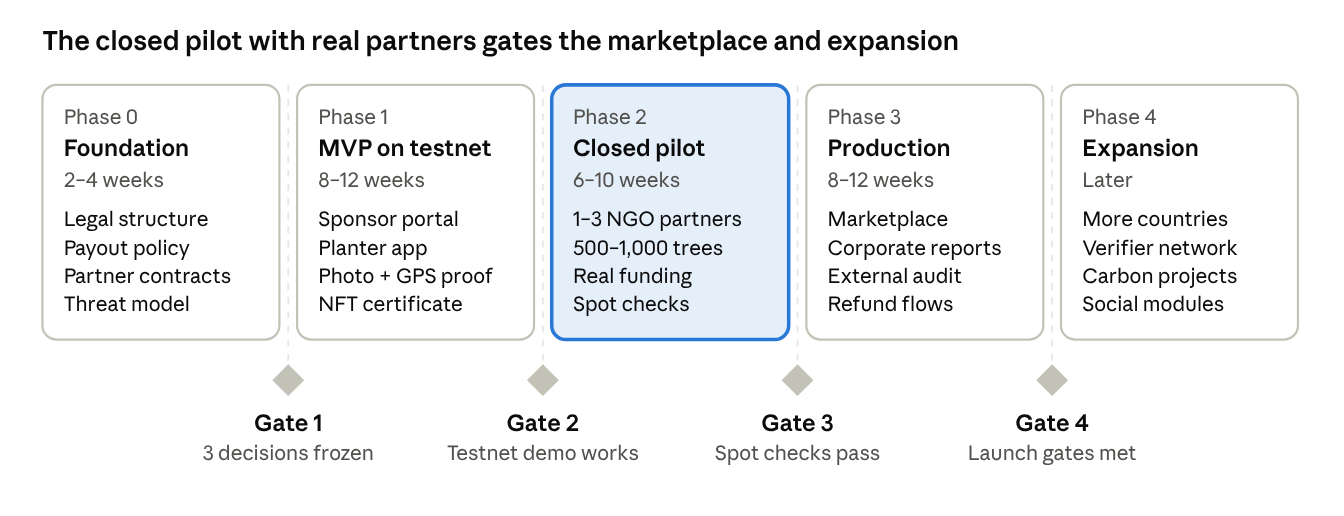
Five phases and four gates. The closed pilot with real partners gates the marketplace and expansion. About 6 to 9 months to a controlled production launch is a planning estimate, not a delivery promise.

Roadmap with five phases and four gates
Phases are not drawn to scale. Gate 4 is the ten launch gates on the technology page.
Phase 0 · 2–4 weeks

Foundation

Legal structure, payout policy, partner contracts, threat model. Gate 1: the 3 decisions are frozen.

Phase 1 · 8–12 weeks

MVP on testnet

Sponsor portal, planter app, photo and GPS proof, NFT certificate. Gate 2: testnet demo works end to end.

Phase 2 · 6–10 weeks

Closed pilot

1–3 NGO partners, first 50–100 live tasks, then 500–1,000 trees if outcomes allow. Gate 3: spot checks pass.

Phase 3 · 8–12 weeks

Production

Marketplace, corporate reports, external audit, refund flows. Gate 4: launch gates met.

Phase 4 · later

Expansion

More countries, verifier network, carbon projects (separate standards workstream), social modules.

First milestone

Sponsor funds, approved planting task, real evidence, independent verification, authorised payment and a Living Tree NFT, end to end on the testnet with failure cases and reconciliation tests.

Before coding starts

Specifications to freeze first

This blueprint is the architecture baseline. Coding can begin on the Ramestta testnet, but not on mainnet. The Developer Execution Specification v1.0 freezes:

  1. Complete SQL schema with constraints and relationships.
  2. Request and response contract for every API.
  3. For each smart contract: functions, permissions, events, errors and invariants.
  4. Screens for every role, mapped to the APIs they call.
  5. State machines for escrow, verification, settlement, refund and maintenance.
  6. Unit, integration, security and end-to-end acceptance tests.
No-go criteria (P0)

When the pilot must stop

  • No signed operating partner and no permitted land sites
  • Funds that do not reconcile, or undisclosed payout beneficiaries
  • An unresolved critical smart-contract audit finding
  • An evidence rejection with no appeal path, or an unchecked payout exception
  • Carbon offsets presented publicly without certification
  • A long-term maintenance promise with no credible funding
  • A data breach, or no way to take down a sensitive public image
Decision register

Suggested defaults and what needs approval

DecisionSuggested defaultStatus
BrandFroxygen for the platform; NFTrees as a moduleProposed
SettlementFiat-first sponsorship; RAMA only for gasGate
FRX 10 billion supplyDo not mint at launchProposed
Donation splitCost-first contracted deliverables; keep 80/10/10 only as an archived exampleGate
NFT 3× or 5× listingOptional suggested asking price onlyProposed
NFT royaltiesExplicit creator rights with a capped royalty the venue can enforceGate
Maintenance durationFunded one-year pilot; 10 or 15-year care as a separate contractGate
Community 50-vote thresholdSupporting signal only; independent final attestationProposed
Carbon creditsNo sale or claim until registry issuanceGate
First region and speciesOne legally permitted Indian cluster; ecology-approved native speciesGate
NFT first-sale share for the sponsor (70/20/10)Design kept, switched off until counsel clears itGate
NFT auto-listingFive successive listing windows, one active at a timeProposed
Replacement identityA new Tree ID and a new NFT, linked both waysProposed
Custody mode at launchFiat custody with an on-chain commitment recordGate

Proposed means the team can adopt it now; Gate means legal, partner, field or governance approval is needed first.

Minimum team

Who builds and runs the pilot

A technical lead, two full-stack engineers, one mobile engineer, one blockchain and security engineer, a product designer, QA, a field-programme coordinator and an ecology consultant, with part-time legal and finance support.

Cost depends on location, hiring mix, compliance scope and partner capacity, so no budget figure is given here.

Risks

Biggest risks

  • Fake or AI-generated evidence
  • No paying sponsor or NGO partner
  • Trees dying after payment
  • Maintenance underfunded over 10 to 15 years
  • A token or NFT being treated as an investment product
  • Pilot costs higher than the placeholder