Home / How it works

How Froxygen works

Seven roles, one core loop: fund, plant, verify, settle, mint and maintain. Everything outside that loop waits until the pilot closes.

Core journey

From sponsor to certificate

A sponsor selects a project and pays

The sponsor picks a project, species and number of trees. The quoted USDT deposit goes into FundingVault, where task obligations and withdrawable credits are recorded on-chain. RAMA pays gas only.

The partner assigns tasks

The implementing partner assigns planters at an approved site with documented land consent.

The planter captures evidence in the app

Site, pit, sapling, planted tree and a species close-up. The browser attaches GPS, time and a live capture challenge. Hardware attestation remains a production gate; independent field review is required.

Checks and review

Automated checks run, then a qualified verifier reviews. Community reviewers add an extra signal on a random sample.

Approval releases payment and mints the NFT

The milestone payment to the planter is released and the Living Tree NFT is minted with a GIF built from the verified frames.

Survival checks and maintenance

On the inspection schedule (day 30, 90, 180 and 365, then yearly or as funded) the planter or inspector uploads a survival check. Maintenance installments release only against verified checks.

If a tree dies

Its status changes to Dead, a replacement task is created and the warranty policy applies. The replacement gets a new Tree ID and a new NFT; the old history is kept.

Task state machine

Only a verified task can settle and mint

A task moves through the stages left to right. A problem at any stage moves it into a named exception state instead. Every transition records the actor, the reason, the evidence version and the time.

  • Exception states: Rejected, Rework requested, Disputed, Payment failed, Funding expired, Refunded, Inspection overdue, Tree dead, Replacement pending, Replaced and Suspended.
  • Replacement: creates a linked new Tree ID; it never deletes old history.
  • Before a task exists: verify the partner and payee details, confirm land consent, approve species and the maintenance plan, then define the site polygon, cost per tree, planting season, survival goal, maintenance term, payment rails and refund conditions.
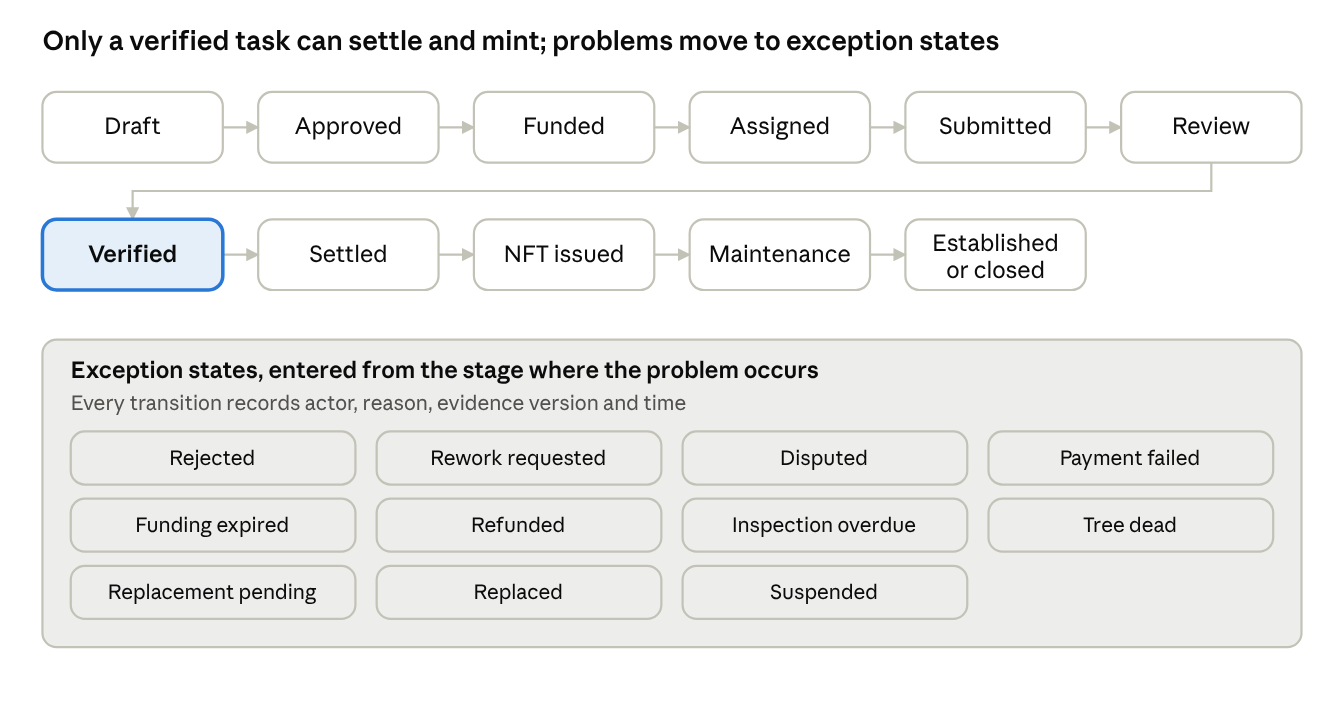
Task state machine diagram
Figure: task state machine, 11 stages and 11 exception states.
Roles

Who does what

RoleWho they areWhat they can doCannot do
SponsorIndividual, company or CSR teamChoose a project and tree count, pay, track each tree, download reports, receive the NFT certificateRelease funds or approve proof
Planter (volunteer)Local worker or volunteerAccept tasks, capture evidence in the app, receive milestone paymentsVerify their own work
VerifierAccredited NGO staff or local inspectorReview evidence, approve or reject, run field audits, handle appealsReceive payment from the same task they verify
Community reviewerRegistered public userGive an extra signal on evidence assigned to them at randomChoose which tree to review; approve alone
CollectorNFT buyerBuy, hold and resell Living Tree NFTs, sponsor extra careClaim ownership of the tree, land or carbon
NGO / partner adminImplementing organisationOnboard sites, assign planters, manage maintenance schedulesChange payout policy
Platform adminFroxygen operationsManage partners, policies and disputes through multisig and role separationMove sponsor funds without on-chain approvals

Corporate or CSR buyer

Runs contracted campaigns with budgets, a dashboard and exportable evidence.

Auditor or regulator

Read-only access to proofs, payment reconciliation, sampled field reviews and the full audit trail.

Governance and treasury signers

Approve timelocked parameter changes, hold the multisig treasury and run emergency procedures.

Inspections

A tree is checked long after planting

Planting is only the first milestone. The pilot inspection schedule keeps checking, and payments for survival and maintenance depend on it.

Day 0
Confirm the tree is planted, on a permitted site, with the correct species.
Day 30
Early viability check; catch immediate mortality.
Day 90
Survival, pest and water-stress review.
Day 180
Photo check plus a sampled independent visit.
Day 365
Year-one survival report, corrective action and cost forecast.
Year 2 onward
Ecology-led intervals, yearly or six-monthly as funded.
Other journeys

More ways to take part

Collector

Buys an NFT on the marketplace (Phase 3) and may sponsor additional care for that tree.

Corporate sponsor

Funds 1,000–10,000 trees as one batch and receives a downloadable audit report.

Dispute

A planter or sponsor appeals a rejection inside a fixed window; a second, unlinked verifier decides.